
Rafaela Prifti
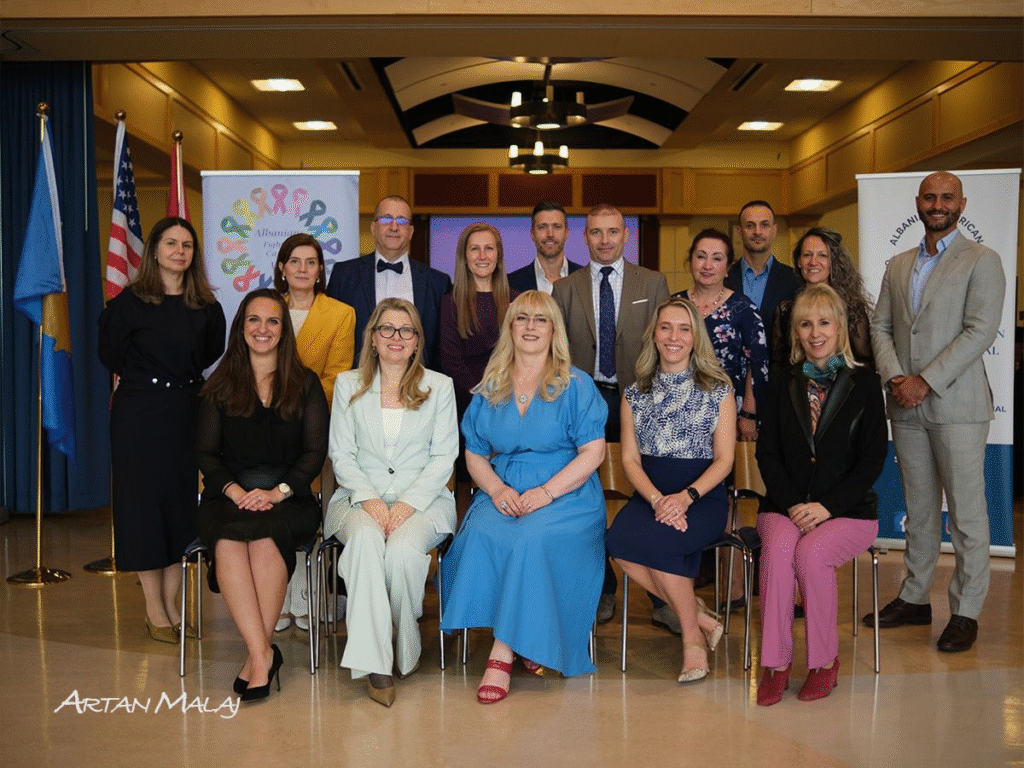
A small black-covered notebook with the AFC logo placed on the white tables of the Boston College High School gymnasium became a dual symbol—knowledge and origin—during the interactive afternoon on gastroenterology hosted by Albanians Fighting Cancer (AFC) and invited physicians from the Albanian American Gastrointestinal Association (AAGA), together with the Albanian community, on Saturday, April 4, in Boston. A “side effect of the presentations” by the specialists was the delivery of topics in the native language, which, for three of the doctors on the panel who had come to America at a very young age, was a new experience. Board member Dr. Agim Aliaj, acting as moderator, paused on the touching message of the opening video to explain the origins of AFC. Connecting the video with the concept of “closeness to one another” at key moments in life, he guided the conversation and discussion while preserving human compassion as the central axis of the afternoon.
The large projector on the wall opposite, the podium, the side stands displaying each association’s logo, the flags, the sponsors’ table nearby, and the vases filled with fresh bouquets in the hall of around 120 participants—including students interested in the field of medicine—served as welcoming markers for a gathering where one expected not only to gain knowledge, but also to actively participate in discussion.
The six-year-old AFC association, founded and led by Roberta Panariti Nashi, and the Albanian American Gastrointestinal Association (AAGA), established last year by Dr. Zana Nikolla, joined forces and, thanks to the working group of Anila, Zana, and Elisa, delivered a conversation at the level of a medical seminar. Regarding awareness-raising, Dr. Nikolla noted that March is dedicated to colorectal cancer awareness. Irritable bowel syndrome (IBS) and increased acidity, including GERD, presented by Dr. Lidia Spaho from Chicago; the causes and concerns of constipation discussed by Dr. Ergen Musa from New Hampshire; the latest knowledge and studies on hepatitis and the liver presented by Dr. Zana Nikolla from New York; and the highly detailed presentation on advanced endoscopy by Dr. Manol Jovani from Florida all emphasized two key points: proactive care and screening (testing). Dr. Olga Ndoci Ndreko, DPT, from Worcester, strongly emphasized that for most digestive system disorders related to the pelvic floor: “Physical therapy should be the first stop, not the last!”
The doctors’ guidance for digestive health begins with diet—particularly fiber intake through a rich consumption of fruits, vegetables, legumes, and whole grains, which is essential for prebiotics that nourish beneficial bacteria—as well as lifestyle, which profoundly impacts digestive well-being. Hydration and mindful eating, stress management, and the gut-brain axis—a two-way communication system—were highlighted, along with the importance of reducing stress as a vital factor in alleviating functional gastrointestinal issues such as IBS, and the importance of daily physical activity.
The key message: The digestive system is not simply a collection of organs that process food, but a complex ecosystem connected to metabolic and immune health, with about 70% of our immunity located in the gut. After the presentations, which lasted about two hours, questions followed on conventional and modernized medicine, the expected role of AI in medical diagnostics, and continued further with one-on-one conversations with the invited doctors. Afterwards, in another part of the hall, near the tall floor-to-ceiling windows, tables were set with Albanian specialties from Maria’s Trattoria and Shkodra Byrek, sponsored by TissueCypher, developed by Castle Biosciences, Inc.
Roberta Nashi expressed gratitude for the generosity of the doctors, sponsors, and all participants in Saturday’s discussion. She emphasized that “the funds from this meeting will be used to support the progress of our initiative to complete the oncology pavilion of the Korça Regional Hospital, which we have just equipped with apparatus and will continue to supply with other necessary equipment.”
Photos by Artan Malaj